12 Axes Test

12 Axes Political Test

60 statements in the short version, 288 in the full one, 7 answers each, scored on 12 axes and matched to 38 ideologies: for self-reflection, not a scientific measurement.

Application · Form 12AExit
Application for a political passport
Government
Diplomacy
Economy
Society
Port of entryTo be completed by the examiner
Countersigned byTo be completed by the examiner
Statement 01 of 60Government · Federal / Unitary

State and local laws should have precedence over national laws

Answers stay on this device.

Keys 1 to 7 pick an answer while the form has focus.

What you get: a specimen passport

This is a specimen of the passport the 12 axes political test issues, with example scores. Finish the test and the passport shows your own twelve positions, your closest ideology and a passport number that comes from your result.

Political PassportSpecimen
Closest ideologySocial LiberalismSupports individual liberty and a market economy while accepting that government should correct inequality and market failures through regulation, public education, health care, and a safety net that widens opportunity for everyone.
Holder
You
Passport no.
12A-GR4W-9AEG
Date of issue
02 OCT 2026
Statements
60
Strongest axis
Progressive 82%
Affiliation
Social Liberalism
Political home
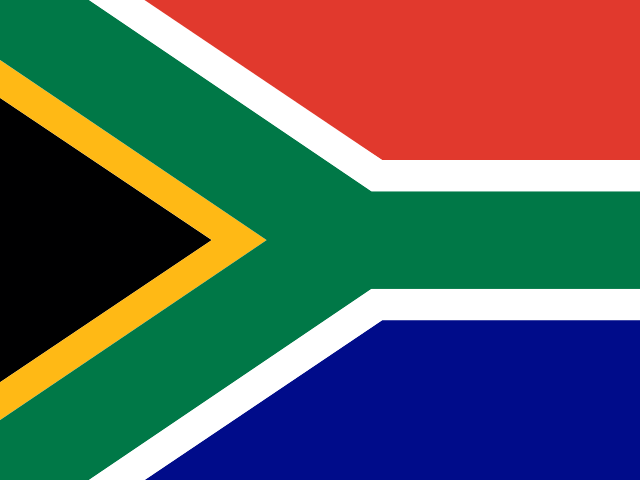
South Africa
Countersigned by
Luiz Inácio Lula da Silva
Countersigned by
Luiz Inácio Lula da Silva
1945– · Brazilian presidentalso vouching: Nelson Mandela · Barack Obama
Progressive82%Internationalism70%Pacifist70%
ISSUED · 02 OCT 2026 · 12 AXES TEST ·93%CLOSENESS
ENTRY GRANTEDSouth AfricaSouth Africa
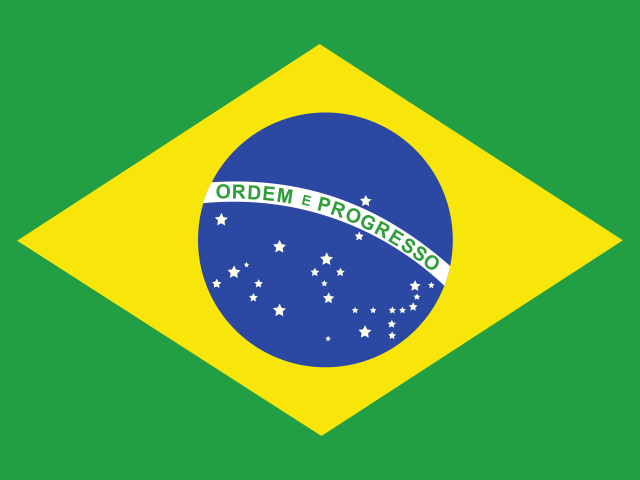
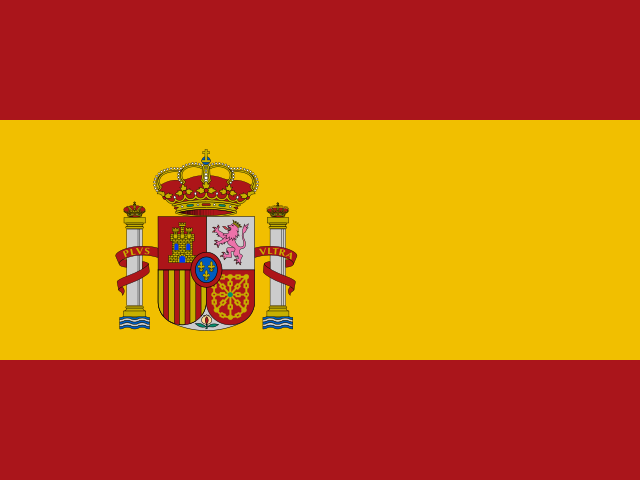
TRANSIT · Brazil 86%TRANSIT · Spain 86%
P‹12A‹‹SOCIAL‹LIBERALISM‹‹‹‹‹‹‹‹‹‹‹‹‹‹‹‹‹‹‹‹
12AGR4W9AEG‹EN‹1Q2I3G3W1O1Y3S244K1Y2C3O3C‹‹‹
  1. 1Guilloche rosetteYour twelve axes, engraved.
  2. 2MicrotextPrinted along the page border.
  3. 3Holographic laminateSwept across on issue.
  4. 4Machine-readable zoneEncodes your result for the share link.

Your twelve positions

Government

Federal 45%55% UnitaryCentrist
Democratic 62%38% AutocraticRepresentative Democracy
Security 35%65% FreedomLiberal

Diplomacy

Internationalism 70%30% NationalismCooperation
Militarist 30%70% PacifistNon-Aggressive
Assimilationist 35%65% MulticulturalistPolyculturalist

Economy

Collectivize 68%32% PrivatizeSocial Democratic
Planned 42%58% MarketsBalanced
Isolationism 66%34% GlobalismLimited Trade

Society

Irreligious 38%62% ReligiousSpiritual
Progressive 82%18% TraditionalCulturally Left
Acceleration 60%40% BioconservativeNeutral

Closest matches

Affiliation

based on 4 axes

Social Liberalism93%
Progressivism89%
Liberalism85%
Social Democracy83%
Social Libertarianism82%

Closeness is 100 minus half the distance on four axes: economy, government, diplomacy and society. The other eight axes do not enter the match.

Closest historical figures

based on all 12 axes

Luiz Inácio Lula da Silva88%
Nelson Mandela84%
Barack Obama83%

Closest countries

based on all 12 axes

South Africa South Africa87%
Brazil Brazil86%
Spain Spain86%

Strongest axes

Progressive82%Internationalism70%Pacifist70%

For self-reflection, not a scientific measurement.

Consular notes

Ideology Social Liberalism

based on 4 axes · 93%

Supports individual liberty and a market economy while accepting that government should correct inequality and market failures through regulation, public education, health care, and a safety net that widens opportunity for everyone.

Source See the full entry

Countersigned by Luiz Inácio Lula da Silva (1945–, Brazilian president)

based on all 12 axes · 88%

Luiz Inácio Lula da Silva is a former metalworker and union leader who served as president of Brazil from 2003 to 2010 and returned to office in 2023. He founded the Workers' Party and emphasizes poverty reduction and social programs.

Source See the full entry

Port of entry South Africa (Unitary parliamentary republic)

based on all 12 axes · 87%

South Africa is a parliamentary republic with nine provinces and a constitution noted for its broad rights guarantees. Governed by a multiparty coalition since 2024, it has a mixed economy with extensive social grants and empowerment policies.

Source See the full entry

The tiers of people and countries are our own estimates from public positions and policies. They are approximate, they are not an endorsement, and they say nothing about the people of any country.

Before you start

Answer how you feel about each statement, not how you think a party would. The 12 axes political test saves your answers in this browser, so a reload keeps your place. For self-reflection, not a scientific measurement.

How the 12 axes political test is scored

Each answer carries a weight: Strongly Agree counts 2, Agree counts 1, Partially Agree counts 0.5, Neutral/Unsure counts 0, Partially Disagree counts −0.5, Disagree counts −1, Strongly Disagree counts −2. A statement from the first four groups of its axis adds its weight, a statement from the last four groups subtracts it. The short version scores an axis as 50 + 5 × the sum, which gives 0 to 100 in steps of 2.5. The full version scores 50 + the sum, which gives 2 to 98 in steps of 0.5. Every score is the percent of the axis' first value.

Which statements you get

The full 12 axes political test asks all 288 statements in a random order. The short test asks 60: for each axis a coin is tossed, heads takes groups 1, 2, 3, 5 and 7, tails takes groups 7, 6, 5, 3 and 1, and one statement of the three in each group is drawn. The 60 statements are then shuffled.

The seven labels of every axis In the 12 axes political test, the label you see next to each axis comes from its score: the bands in the first row, from the first value's extreme to the second value's extreme.
Axis>9075–9060–7540–6025–4010–250–10
Federal – UnitaryConfederalFederationalFederalCentristUnitaryCentralizedExtremely Centralized
Democratic – AutocraticLiquid DemocracyDirect DemocracyRepresentative DemocracyCentristBicameralOligarchyAutocracy
Internationalism – NationalismWorld GovernmentInternationalismCooperationNon-InterventionistAnti-InterventionistNationalistUltranationalist
Militarist – PacifistExpansionistMilitaristMilitary-FocusedNeutralNon-AggressivePacifistAnti-War
Security – FreedomTotalitarianAuthoritarianStatistCentristLiberalLibertarianAnarchist
Collectivize – PrivatizeCommunistSocialistSocial DemocraticMixed EconomicEconomic LiberalCapitalistExtreme Capitalist
Irreligious – ReligiousAntitheistAtheistAgnosticModerateSpiritualReligiousUltra-religious
Progressive – TraditionalRevolutionaryCulturally LeftProgressiveModerateConservativeTraditionalistReactionary
Assimilationist – MulticulturalistEthnonationalistMonoculturalistAssimilationistCentristPolyculturalistMulticulturalistRacially Colorblind
Planned – MarketsPlanned EconomyInterventionismRegulationismBalancedMarketsFree MarketLaissez-Faire
Isolationism – GlobalismIsolationistProtectionistLimited TradeModerateFree TradeGlobalistGlobal Economy
Acceleration – BioconservativeTranshumanistAccelerationistTechnologicalNeutralBioconservativeDecelerationistPrimitive

How the closest ideology is chosen

In the 12 axes political test the library holds 38 ideologies, each with four values from 0 to 100 for economy, government, diplomacy and society. Your scores on Collectivize–Privatize, Security–Freedom, Internationalism–Nationalism and Progressive–Traditional are compared with them. The ideology with the smallest sum of squared differences is your closest match, and the next four are shown too. Closeness is 100 minus half the distance, rounded, so 100 means the same four values. The other eight axes are not part of the match.

Questions

How long does the 12 axes political test take?

The short version has 60 statements and takes about 10 minutes; the full version has 288 and takes about 45. Your progress is saved in your browser, so you can close the tab and come back.

What do the seven answer options mean, and how much does each one count?

Strongly Agree counts 2, Agree counts 1, Partially Agree counts 0.5, Neutral/Unsure counts 0, Partially Disagree counts −0.5, Disagree counts −1, Strongly Disagree counts −2. Neutral/Unsure adds nothing to either side.

How does the ideology match work?

Four of your twelve scores, economy, government, diplomacy and society, are compared with the same four values of each of the 38 ideologies. The smallest distance wins. Closeness is 100 minus half the distance, rounded, and the next four ideologies are shown as well.

Can I go back and change an answer?

Yes. Back takes the last answer and its points away, and you can step back as far as the first statement. After the passport is issued, start over to change answers.

Are my answers saved or sent anywhere?

Answers are kept only in your browser's local storage, so a reload keeps your place. They are never sent to a server. A share link holds just your twelve scores.

How do I share my result?

After the passport is issued, use Save passport image for a 1080 × 1350 picture, or copy the result link, or send it by WhatsApp or X. The link opens the same passport, with the same number and the same twelve scores.

What do labels like Social Democratic or Libertarian on my result mean?

Every axis has seven labels, one for each score band. Social Democratic is the label for a score above 60 and up to 75 on Collectivize–Privatize, Libertarian the label for 10 to 25 on Security–Freedom. The table above lists all seven for every axis.

Why are some statements worded differently from the original 12axes quiz?

The statements come from the open-source bank under the MIT license. A few that read as insults or calls to harm were reworded in a milder tone with the same direction, so they push the same axis the same way. Scoring, weights and the choice of statements are unchanged.

How are my closest historical figure and country chosen?

Every person and every country has a tier from 0 to 6 on each of the 12 axes, set by us from public positions and policies; the tiers stand for the scores 95, 83, 68, 50, 32, 17, 5. Your twelve scores are compared with them, and the closeness is 100 minus the root-mean-square gap over all twelve axes. The closest one is shown with two runners-up. These are rough estimates, not an endorsement and not a judgement of any country's people.